Defining a Pirate: An In-Depth Look at Curse of the Black Pearl


To begin this series examining the Pirates of the Caribbean series, I will be performing a deep analyses of the first film in the Gore Verbinski trilogy, The Curse of the Black Pearl. This film launched an entire film franchise, but it wasn’t expected to do so. Those who know their Disney history will know that the studio initially expected a film based on the Pirates of the Caribbean ride to fail at the box office, though they were happily proven wrong when Curse of the Black Pearl hit theaters on June 28, 2003. As well as being an overall entertaining and swashbuckling piece of classic film, this first Pirates film also approaches classic story structure and character convention from a new angle, pillaging its own cliches in an act of cinematic piracy.

Curse of the Black Pearl follows the classic “Hero’s Journey” story template, but — aptly for a film about pirates — turns the convention on its head and breaks the rules. Instead of Luke Skywalker, a humble moisture farmer from the desert planet of Tattooine jetting off to the stars to fight the evil Galactic Empire, Curse is a tale about Jack Sparrow, the former captain of the Black Pearl, who seeks revenge upon his mutinous first mate, Hector Barbossa. Right?
Wrong.
Contrary to popular belief, Jack Sparrow is not the main character of Pirates of the Caribbean, at least when Gore Verbinski was directing. I’ll talk more about this as part of my analyses of On Stranger Tides and Dead Men Tell No Tales, and instead focus on the actual main character of this series: Elizabeth Swann.

This is a fact that’s not immediately obvious, as Pirates — especially Curse of the Black Pearl — doesn’t focus as much on individual characters as it does on ideas. This is not true of all Pirates media — the Young Jack Sparrow books are told entirely from Jack Sparrow’s perspective as is On Stranger Tides, and they were quite successful in that pursuit — but the films have other goals in mind. While Will Turner and Jack Sparrow do have their own stories in Gore Verbinski’s trilogy, and even just within Curse, the main arc of this trilogy is Elizabeth’s journey towards becoming a pirate — or perhaps more accurately, fulfilling her destiny of becoming a pirate.

Indeed, it could be argued that Elizabeth has been a pirate since childhood, as the first on-screen act of piracy in the whole series is performed by Elizabeth when she steals Will’s medallion. Not only is this theft, but it is the theft of a pirate artifact. But what exactly defines a pirate?

The main thesis of Curse of the Black Pearl seems to hinge around this question, as well as its crucial follow-up that we’ll get to in a minute. The question of how piracy is defined within the film and without is an interesting one, and Curse gives several answers from the perspectives of several different characters. Let’s go through these different ideas one by one:
“Any man who sails under the name of pirate should get exactly what he deserves — a short drop and a sudden stop.”

Commodore James Norrington’s opinion, though mostly black and white and not particularly allowing for exception or redemption, is not without justified foundation. In real life, pirates were known to commit the most heinous of crimes, as well as simple thievery and swashbuckling. Norrington’s view is that pirates pose such a grave threat to the public safety that the only good pirate is a dead one, indicated by his insistence on hanging Jack even after he has just saved Elizabeth. However, Norrington's beef with Jack isn't just because he's a scoundrel: he believes that Jack has done back things — crimes that need to be punished to the utmost extent of the law; which is why his view of “the only good pirate is a dead pirate” does not extend to Will and Elizabeth at the end of the film: in his view, neither Will nor Elizabeth did anything wrong besides repaying a debt to a criminal who helped them. Both Norrington and Governor Swann were willing to grant Will and Elizabeth clemency for helping Jack, and Norrington holds to this even after they help Jack escape his execution. Norrington still wants Jack's head, but his earlier statement that "One good deed is not enough to redeem a man of a lifetime of wickedness" holds true in the reverse: one seemingly wicked deed is not enough to condemn Will and Elizabeth — and it also plants a seed in Norrington's mind that perhaps his staunch stance isn't necessarily right. This will be important to remember when we talk about At World’s End, so put a pin in this.
“I practice three hours a day so that if I meet a pirate… I can kill it!”

At the beginning of the film, there seems to be no love lost between Will Turner and pirates, for reasons not entirely made clear. It’s possible that Will hates pirates because he was taught to hate pirates. If you think about it, Will never actually has met a pirate, but he's grown up around figures like Governor Weatherby Swann and Commodore James Norrington, both of whom detest pirates and all forms of piracy.
And yet the above quote also implies something about Will that’s never stated explicitly: Will admires pirates to a degree, possibly because of his own station. Will is a blacksmith’s apprentice, which is not the most glamorous job to begin with, but even less so when you realize that Will does all the actual work while his master simply lies around drunk all the time. Will doesn't get the glory of admiration from Governor Swann over the sword he made for Norrington; he probably doesn't even get much of a fair pay. It’s not hard to figure out that Will feels trapped in Port Royal, and so his desire to free himself from this prison ends up conflicting with his ingrained belief that Pirates are scum; despite his better judgement, Will wants to be a pirate to some degree. His arc throughout the film will see him come to terms with his desire, and with the fact that piracy is in his blood, becoming more and more a pirate as the film progresses. As the son of Bootstrap Bill Turner, Will has a touch of destiny about him, which will not be fully revealed until much later on...
Read about Will's acts of piracy in Curse of the Black Pearl
Goes above his station to address Elizabeth by her first name
Busts Jack out of prison so he can save Elizabeth - his first act of piracy that is actually a crime
Helps Jack steal the Interceptor, using deception to headfake Norrington by initially appearing to steal the Dauntless
Double-crosses Jack on the Isla de Muerta
Threatening Barbossa in order to secure the safety of Elizabeth, Jack, and the crew
Uses deception to help Jack break the Curse of Cortéz and defeat Barbossa
Rescuing Jack from the gallows
Winning the heart of Elizabeth, "stealing" her away from Norrington
“Everyone’s thinkin’ it, I’m just sayin’ it… pirates!”

Gibbs’ approach to pirates is a pragmatic one. Love them or hate them, they are dangerous, and one should exercise prudence when dealing with pirates. At the beginning of the film, the only emotion he has towards pirates is one of fear and caution; by the next time we see him, he has become a pirate, complete with a relationship with Jack Sparrow. Gibbs was originally a sailor in the Royal Navy, sailing under the command of not-yet-Commodore Norrington, but at some point abandoned the navy for Tortuga. Perhaps he preferred to get away from the prying eyes of the crown, perhaps reasoning also that he would be safer to walk among pirates in Tortuga and stay out of their way than he would be as a poor man in polite company. Eventually, he’ll move on from his apparent neutrality and opportunism and come to stand for an ideal, but he won’t get there until At World’s End.
“Actually, I think they’re rather fascinating!”

Elizabeth’s viewpoint about pirates is the largely mythological one that is the view of the general public today: pirates were dangerous scoundrels and more often than not horrible people, but they were also cool as hell. Her fascination with pirates leads her to research them extensibly, therefore turning her into one of the most knowledgeable characters when it comes to the subject of pirate lore. Not only does she already know who Jack Sparrow is when she meets him, as well as his legend, but she is also familiar with the Black Pearl, and has such a deep knowledge of the Pirate Code that she is able to converse fluently about it to Barbossa and his crew, possibly even being more literate in the Code than most of the other pirates in the film. Most importantly, Elizabeth longs for adventure and freedom; she wants to be a pirate, and throughout the film performs what may be called acts of "soft piracy," which grow ever more bold and explicit as the film continues.
Read about Elizabeth's acts of piracy in Curse of the Black Pearl:
1. Stealing the medallion from Will
2. Actively participating in pirate politics by invoking the Right of Parley against Pintel and Ragetti
3. Using deceptive tactics against Barbossa to secure the safety of Port Royal
4. Refusing to tell Barbossa where or who Will was
5. Getting Jack drunk so she could burn the rum and get help from Norrington
6. Deceiving Norrington as well as her own father in order to help Will
7. Participating in the plot to rescue Jack from the gallows
8. Breaking her promise to marry Norrington in favor of being with Will

Among all these perspectives is the notion that pirates are free from the constraints of authority, particularly that of the tyrannical British Empire (which is largely why the golden-age pirates would initially set sail, as well as why they opted for the democratic systems they used on their ships). It would seem that all of the characters examined believe that piracy equals freedom. Even Norrington probably believes this to some degree, but at the moment is not ready to admit it to himself, or perhaps doesn't realize that harm that authority like his is causing. So if piracy equals freedom, then what does freedom mean? To answer this question, let’s return to the archetypes in the Hero’s Journey to examine the perspectives of Jack Sparrow and Hector Barbossa.

At first glance, it would, as stated at the beginning of this essay, be easy to mistake Jack Sparrow as the hero of Curse of the Black Pearl, and Barbossa as the villain. Neither is really true, as both fall into a different and perhaps more interesting character archetype that’s particularly common to the Hero’s Journey: the Mentor.
Yes, you read that right. Jack and Barbossa are both the mentor in the story. This is because neither really sets out on their journeys for or against the motivations of the hero, Elizabeth, and her love interest, Will. Barbossa has no particular animosity towards Elizabeth: he only wants the medallion, and the blood of Bootstrap Bill to free himself and his crew from the curse. In fact, had Elizabeth’s blood worked, he gave no indication that he wasn’t going to set her free when the curse was lifted — “Waste not,” he tells her — and his only motivation to kill Will is his frustration that Elizabeth’s blood didn’t work. All Barbossa wants is to eat his apple.
If anything, Jack’s goal was more villainous: he wanted to kill Barbossa as revenge for the mutiny he performed. Barbossa didn’t need to kill anybody to get his goal, though he does kill several people in battle throughout the film. However, though Jack prefers cleverness and deception to get his goals, Jack’s goal in the film was murder. They are both grey characters: neither good nor evil, just simply pirates.
So what makes them mentor figures?

The mentor is the person in the story who is usually older than the hero, and who can impart wisdom or teachings to the hero. For whatever reasons they may have, they do not accept the hero’s mission as their own, but are willing to assist the hero. Barbossa and Jack both do this, each more or less taking a turn mentoring Will and Elizabeth separately before they are all gathered together on the Isla de Muerta. And what Jack and Barbossa teach their students is how to be a pirate: the thing both of them really want; and each of the two men imparts wisdom about the benefits, meanings, and most importantly, the costs of being a pirate.
For starters, it is worth noting that both Jack and Barbossa believe that piracy equals freedom, just as most of the non-pirates do. However, throughout the course of the film, both of them, in one way or another, have been deprived of their freedom, giving them each complex and interesting perspectives on what that means, each agreeing in the end that you don’t know what you have until it’s gone.
“What a ship is… is freedom.”

Jack’s belief was that owning a ship and being the captain of a crew freed you from all constraints. You could go anywhere you wanted, without a care in the world, and that the great joy of piracy was simply the agency of having the entire ocean to sail across. Yes, Jack was a thief and a cad, but it is suggested that most of his great feats were performed in a clandestine manner that rarely involved hurting anyone. Elizabeth states that Jack had sacked the port of Nassau without firing a single shot, which could of course just be legend, but Jack’s behavior throughout the film backs this up: he prefers to sneak around rather than charge into a fight — a preference that later films will require him to grow beyond.
This technique leads to Jack becoming a legendary figure, sometimes referred to as "The greatest pirate I've ever seen" by certain Lieutenants of the Royal Navy who are not given a name onscreen until On Stranger Tides. It also leads to Jack begin "the worst Pirate I've ever heard of" in the eyes of Norrington; and Norrington is not entirely wrong.
Jack's major flaw, in the end, is desire to avoid conflict and run away whenever possible, and it's an issue that plagues him in all three films of the Verbinski trilogy. Jack is often indecisive, and more importantly, has difficulty being authoritative. He also keeps much of his plans close to the vest, resulting in characters like Will being uninformed as to Jack's true intentions, making him a poor leader. This ultimately results in his own mutiny, an oar across the head, and later his own death. As a matter of fact, one of the wisest things Jack does in the whole series is cede leadership, but that's a lesson he won't learn for a whole two-and-a-half movies.

Jack spends most of the film mentoring Will in the ways of Piracy, passing on his method of navigating the world of pirates that runs under the radar, negotiates, deceives, and gets away clean, without ever firing a shot. After all, why fight when you can goad a bar full of drunk pirates to do it for you? Will follows these lessons like a prize pupil, including when he senses that Jack does not have his best interest at heart: Will double-crosses Jack before Jack can double-cross him — although he does this already having learned from Jack that backstabbing in the world of pirates is not the same thing as a betrayal. Backstabbing can be fixed by everything working out as it was supposed to for both parties — all's well that ends well; but a full-fledged betrayal, such as a mutiny, can never be undone. Jack and Will will come to test this notion and push it to its limits throughout the trilogy, but these lessons will hold true, and the two men will be better friends in the end as a result.

While Will gets to learn how Jack's method works when things are going according to plan, Elizabeth learns the harder truth: what happens when things go wrong, and that everything is never as it seems.
Yes, I did just quote Owl City in an essay about Pirates of the Caribbean. I have no regrets.

Elizabeth's introduction to Jack sees him seeming every bit the legendary pirate she's read about. He saves her life; he plays nice with Norrington; then he threatens her ("only a little") in order to bargain for his escape. Elizabeth does not see him again until the battle between the Interceptor and the Pearl, after which they are both marooned on the same island Jack had previously escaped from. It is here that the lesson begins.
Elizabeth gets the cold reality that sometimes the pirates' life isn't all it's cracked up to be. Sometimes you get marooned on an island with a drunk former captain, and sometimes legendary figures are more myth than legend. The story as everyone knows it is that Jack escaped being marooned on the island by waiting in the tide three days and three nights until all manner of sea creatures came up to him, and he was able to tie some sea turtles together to make a raft. Surely, it's clear that this is an absurd story (though Gibbs maybe believes it?), but that doesn't make the true story that he was able to barter passage off the island because it was a smuggling station for rum runners any less disappointing. What's worse is, because of Norrington, the rum runners are no longer in business, so they are left with nothing but a stash of the "vile drink that turns even the most respectable men into complete scoundrels" and no way out. So Elizabeth waits until Jack passes out drunk, and then burns all the rum to create a smoke signal in order to get help, which arrives in the form of Norrington. This is a very pirate-y act — double crossing jack in order to get them to safety — but clearly, this is not in Jack's playbook. This is because Elizabeth is not, at heart, a student of Jack Sparrow.
"I feel nothing — not the wind on my face, nor the spray of the sea, nor the warmth of a woman's flesh. You best start believin' in ghost stories, Miss Turner — you're in one!"

Barbossa is an interesting character in Curse. He's not exactly the villain (though he is the antagonist), and he's not your typical mentor. His belief was that being a pirate meant that what you wanted was yours to take. And while Jack also exemplifies this behavior (after all, he is still a pirate), Barbossa does something that Jack is unwilling to do in most circumstances, which is to fight for what he desires. At its core, there is nothing inherently wrong with this philosophy, but Barbossa demonstrates where it goes wrong.
Barbossa takes what he wants by force. He takes the Black Pearl away from Jack after tricking him into revealing the location of the treasure; he takes the Aztec gold and spends it everywhere. All this taking ends up with him as a cursed man, unable to die, and unable to live; and so he must retrieve all 882 identical pieces of the Aztec gold, which he does — by force — except with Elizabeth.
This is because Barbossa has one other thing, seemingly, that Jack does not: a sense of fair play. This may seem odd, because Barbossa deceives both our main characters in the film at some point, but as odd as it may seem, he does so within the confines of negotiated terms. The first example is during the attack on Port Royal.
Elizabeth requests a Parlay with the captain, requiring Pintel and Ragetti to take her to the Black Pearl unharmed. There, she meets Barbossa and negotiates for the safety of Port Royal (I might add, using the Pirate Code and pirate diplomacy to do so). She bargains with the medallion, but her attempts to seem as nobody of interest by using the name Turner instead of her own name of Swann lead to her being very much a person of interest; therefore, Barbossa agrees to leave Port Royal, but keeps Elizabeth aboard the ship, pointing out that her return to shore was not part of the bargain — and in fact, it wasn't. Elizabeth never specifies that she is to be returned to shore.
Later, Will tries to negotiate for Elizabeth's freedom and the safety of the crew of the Black Pearl, but again fails to specify, leading to Elizabeth being marooned on an island and the crew to be kept safe and sound... in the dirty brig of the Black Pearl. As Barbossa points out, "I agreed she go free but it was you who failed to specify when or where." Barbossa here teaches Will and Elizabeth crucial lessons in craft and forethought, both key elements to piracy that both Jack and Barbossa possess, and which will be the knife's edge that the final battle rests upon. Barbossa exploits the fact that neither Will nor Elizabeth factored into their negotiations that Barbossa is a pirate, and they both failed to tie up all their loose ends. More on this in a second.
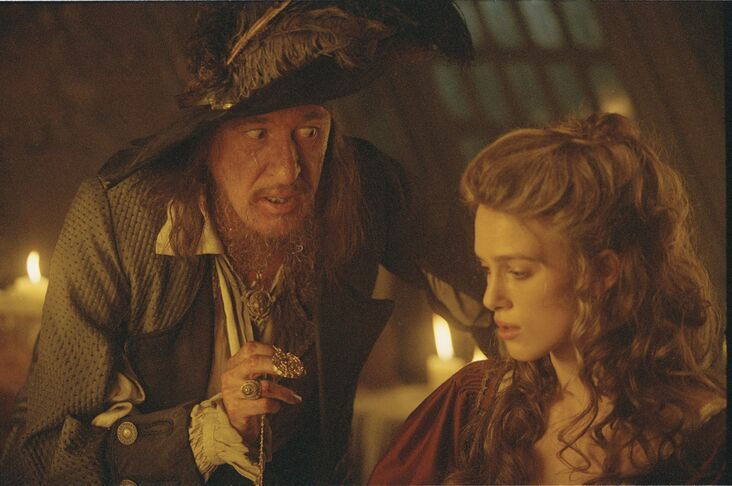
The most important thing that Barbossa teaches either Will or Elizabeth (but mainly Elizabeth) is the costs of greed. The curse took from him all manner of pleasant feeling, and left him only with pain and suffering. Barbossa is always starving; he can never drink enough to satisfy his thirst. Whenever he steps into the moonlight, he becomes a hideous, half-dead monster. All Barbossa wants is to be free, and to eat his apple. This is the cost of the entire way Barbossa has been living: the ruthless, violent betrayer who takes and takes, and kills, and performs mutinies, and straps an honorable pirate to a cannon to sink to the bottom of the sea. Through his behavior, he has made an enemy of the Aztec gods, and must repay his sins in blood; but he has also made an enemy of Jack Sparrow. And while he payed back the gold and the blood, he fails to make amends to his fellows.
It is this failure to truly repent and change his ways after seeing the costs that leads Barbossa to the final battle, in which he forgets his own lessons to Will and Elizabeth about forethought, and about paying attention. Barbossa is so enraged by the curse and by Jack that he forgets to factor in Will and Elizabeth; he is so focused on Jack that he doesn't see them take out his crew members who remained with him on the Isla de Muerta while the rest went to fight Norrington; and he allows himself to miss Jack and Will replacing the medallions... and repaying the blood. Therefore, Barbossa's greed and anger leads him to walk into his own death. In a cruel twist of fate, he feels again, only to feel the cold release of death; and he dies with his apple in hand.

Though Barbossa perishes at the end of Curse of the Black Pearl, his lessons remain, especially with Elizabeth. In the coming films, her style of piracy, though not fully formed, continues to resemble that of Barbossa, with aggressive campaigns for her desires, deceitful tactics achieved sometimes through honesty, sometimes not, the occasional despicable act, and eventually, leadership through bold actions and charisma. She will see both the benefits of this style, as well as its drawbacks and curses. We'll see all of this in due time, in the next entry in this series, covering Pirates of the Caribbean: Dead Man's Chest. Until then, my friends...
...bring me that horizon.


Comments